
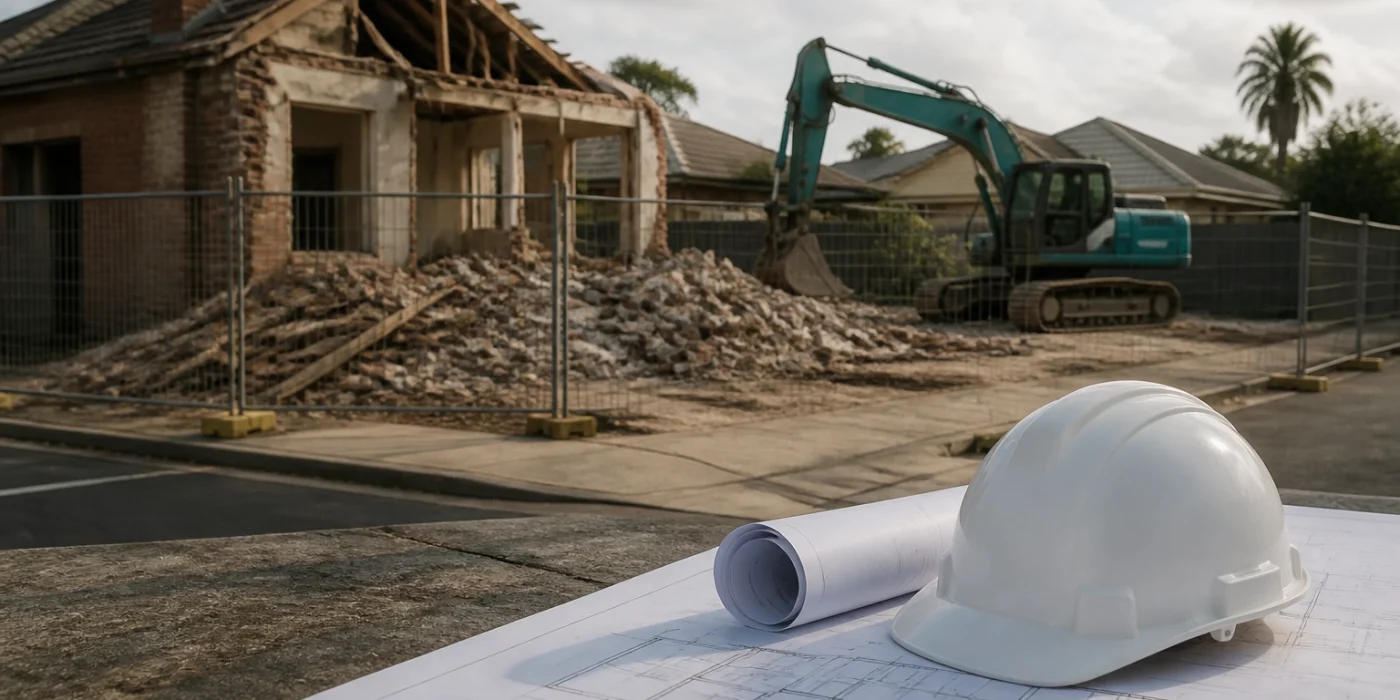
Most homeowners planning a knock down rebuild Newcastle project start by calling a builder. It seems logical. You want a new home, so you find someone to build it. But this approach skips the most consequential step in the entire process, and that oversight can cost you months of delays, unexpected compliance costs, and serious legal exposure before a single foundation is poured.
Demolition is not a prelude to your project. It is the foundation of it. The licensed demolition contractor you engage before any builder sets foot on your property determines your timeline, your regulatory standing, and your financial risk. NSW law is specific about who can perform this work, what qualifications they must hold, and what obligations fall directly on you as the property owner.
This guide covers everything Newcastle homeowners need to understand before starting a knock down rebuild. You will learn what demolition licensing actually requires under NSW law, why a licensed builder cannot simply take on demolition work, how asbestos obligations apply to your site, what demolition costs look like within a full project budget, and how to choose the right contractor with confidence.
Why Demolition Is the Foundation of Every Knock Down Rebuild
A knock-down-rebuild in Newcastle has two distinct phases: demolition and construction. Most homeowners focus on the build, the floor plan, the façade, the fittings. But the demolition phase is what determines whether construction starts on time, on budget, and with a clean compliance record.
This distinction matters because the consequences of getting demolition wrong fall on the homeowner, not just the contractor. Unlicensed work, improper asbestos handling, illegal waste disposal, and missed council approvals can each trigger fines, remediation costs, and project delays that compound quickly. See how this plays out in practice with a completed West Wallsend knock-down-rebuild project.
The other critical point that surprises many Newcastle homeowners: your builder cannot manage this for you. Under NSW law, a builder’s licence authorises construction. It does not authorise structural demolition, hazardous materials management, or the supervision of takedown work. Demolition is separately licensed and regulated by SafeWork NSW, with its own licence categories, named supervisor requirements, and regulatory obligations. These are not administrative details, they are the legal boundary between a project that proceeds smoothly and one that stalls before a slab is poured.
Understanding what a licensed demolition contractor does, and what happens when that expertise is absent, is the most important preparation a Newcastle homeowner can do before committing to a knock-down-rebuild project.
NSW Demolition Licensing: What the Law Actually Requires
Demolition work in NSW is licensed and regulated by SafeWork NSW. Two distinct licence categories define what a contractor is legally permitted to do.
The restricted demolition licence covers structures between 6 and 15 metres high. This is the relevant category for most residential knock-down-rebuild projects in Newcastle. The unrestricted demolition licence applies to anything more complex: structures over 15 metres, chemical installations, tower crane projects, mobile cranes exceeding 100 tonnes capacity, pre- or post-tensioned structural components, floor propping, and explosives. Residential exceptions exist for heritage properties, contaminated sites, and unusual structural configurations, all of which can push a project into unrestricted territory.
Licence validity has recently changed. From 1 March 2023, licences granted in NSW run for five years rather than two. This reduces the risk of engaging a contractor whose licence has lapsed mid-project, but it does not eliminate it. Always verify currency directly through the SafeWork NSW licence check tool before signing anything.
The named supervisor requirement is frequently misunderstood. A named supervisor must be physically present on-site at all times during demolition work. This is an active, on-site obligation, not a paperwork formality. The supervisor’s name is attached to the licence, and their qualifications must remain current. Supervisors holding a restricted licence must have experience no older than five years; unrestricted licence supervisors require experience no older than ten years across all demolition types.
Training requirements also shifted on 1 July 2025, moving from 11 to 10 updated units of competency. Supervisors who qualified before that date retain grandfathered status. Anyone applying after 30 June 2026 must complete the new units. Asking a prospective contractor about their supervisor’s qualifications and when they were last assessed is a straightforward and entirely reasonable question.
The application and renewal fee for a demolition licence sits at $2,904.00 for the 2026-27 period. That figure reflects the regulatory weight attached to this work. A contractor who hesitates or cannot produce current licence documentation should not be considered for your project.
For homeowners in Newcastle, engaging Newcastle’s trusted demolition experts means working with a contractor whose licensing, supervision, and compliance obligations are already in order before the first day on site.
What a Licensed Builder Cannot Do on a Demolition Site
Knowing what a demolition licence covers is only half the picture. The other half is understanding what a builder’s licence does not cover, because this is where Newcastle homeowners most commonly make costly assumptions.
A builder’s licence, issued under the Home Building Act 1989, authorises construction work. It does not authorise structural demolition, hazardous materials management during takedown, or supervision of workers performing demolition tasks. Those activities fall under a separate regulatory regime entirely. A builder who takes responsibility for the demolition phase without holding a current demolition licence is performing unlicensed work on regulated activities, regardless of their construction credentials.
The liability exposure here falls on the homeowner. If an incident occurs during a demolition phase managed without the correct licence, whether a structural collapse, an asbestos fibre release, or an illegal waste disposal event, the homeowner may be found to have engaged unlicensed contractors for regulated work. This is not a theoretical scenario; it is the direct consequence of misunderstanding which licence applies to which phase.
The builder’s role begins after the site is cleared. Before a building permit can commence, the demolition contractor must provide specific documentation: site clearance certification confirming the site is structurally clear, and where asbestos was present, a clearance report signed by a licensed asbestos assessor. A builder cannot generate these documents. Only the demolition contractor can.
Engaging a residential demolition contractor independently, before appointing a builder, is the correct sequence. The contractor’s findings during site assessment, covering soil condition, foundation remnants, existing service connections, and contamination, give your builder the accurate site information they need to scope preliminary works and price honestly. A builder quoting without that information is working from incomplete data, and their estimates will reflect it.
The Pre-Demolition Assessment: What Gets Evaluated Before a Single Wall Comes Down
Once the licensing question is settled, the next step is the one that determines everything else: the pre-demolition assessment. This is a formal site evaluation conducted by the licensed demolition contractor, and it is categorically different from the site inspection a builder performs. A builder assesses construction feasibility. A demolition contractor assesses hazards, regulatory obligations, and sequencing requirements. The two exercises are not interchangeable.
Asbestos identification is typically the most consequential part of this assessment. Approximately one in three Australian homes still contain asbestos, and in Newcastle’s older residential areas, that proportion is higher. Homes built before 1987 are highly likely to contain asbestos-containing materials (ACMs); those built between 1987 and 1990 are likely to contain some. Common locations include fibro sheeting, roof tiles, eave linings, floor adhesives, pipe lagging, and insulation. A licensed asbestos assessor must identify and document every ACM before demolition begins. This is a legal requirement, not a recommendation.
The assessment also maps the structural configuration of the property: load-bearing elements, any party walls on semi-detached or terrace properties, underground services (gas, water, electricity, stormwater, and telecommunications), and any slab, foundation, or basement structures that will require earthworks after the structure is removed.
Environmental factors are assessed at the same time. Prior fuel storage, chemical use history, and soil contamination all affect demolition scope, waste disposal classification, and total project cost. Discovering a buried fuel tank mid-demolition is an expensive problem. Identifying it beforehand is a manageable one.
Council notification and approval pathways are also confirmed at this stage. Most residential demolitions in Newcastle require either a Development Application or a Complying Development Certificate. The assessment findings directly inform which pathway applies and what conditions will attach to the approval.
Finally, the pre-demolition assessment is when an accurate, fixed-price quote becomes possible. A contractor who quotes before completing this process is quoting on assumptions. If you want a reliable number before committing your budget, speak to our residential demolition experts and ask for a site assessment first.
Asbestos Removal in Newcastle: Obligations That Cannot Be Skipped
Of all the hazards identified during a pre-demolition assessment, asbestos is the one that most consistently determines whether a Newcastle knock-down-rebuild proceeds on schedule or stalls entirely.
Newcastle’s older residential areas carry a high concentration of pre-1990 housing stock where asbestos-containing materials (ACMs) are common, as noted in the pre-demolition assessment section above.
NSW law is unambiguous on what must happen before demolition can proceed. All ACMs must be identified, removed, and disposed of by licensed professionals. Friable asbestos requires a Class A removalist. Non-friable (bonded) asbestos above 10m² requires a Class B removalist. Confirm current requirements with SafeWork NSW before assuming which applies to your site.
The removalist must notify SafeWork NSW in writing at least five days before work commences, adding to the pre-demolition timeline.
Once removal is complete, an independent licensed asbestos assessor must conduct a clearance inspection and issue a clearance certificate confirming the site is safe. Without it, demolition cannot lawfully proceed and no builder can legally mobilise.
Illegal asbestos dumping is a documented problem in the demolition industry. Contractors offering prices significantly below market rate often achieve that margin by disposing of waste illegally. The legal liability does not disappear when the truck leaves; it follows the waste and can follow the homeowner who engaged the contractor. Requesting waste transport documentation from any contractor you consider is basic due diligence.
Hunter Valley Group holds full licensing for licensed asbestos removal in Newcastle, with all waste disposal documented and directed to approved facilities. If you are considering a career in compliant demolition work, our asbestos removal team works to the same standards on every site. Confirm equivalent practices with any contractor you engage, before price becomes the deciding factor.
Waste Disposal Compliance: Why It Is Your Liability, Not Just the Contractor’s
Asbestos is the most visible hazardous waste category, but it is not the only one. A standard residential demolition in Newcastle generates significant volumes of regulated waste beyond asbestos: timber, concrete, brick, plasterboard, lead paint debris, and potentially contaminated soil. Under the Protection of the Environment Operations Act 1997 (POEO Act) and NSW Waste Regulations, all of it must be correctly classified, transported to licensed facilities, and documented.
What many homeowners do not realise is that this obligation extends to them. If a contractor illegally dumps waste generated on your property, the NSW EPA can pursue enforcement action against both the contractor and the landowner. Penalties for individuals reach $250,000 plus $60,000 per day for continuing offences. This is not a remote scenario; the EPA holds broad investigative powers and actively pursues illegal dumping across NSW, including the Greater Newcastle region.
Before engaging a demolition contractor for your knock down rebuild, request written confirmation of their waste management approach: which licensed facilities they use, how materials are classified and sorted on site, and whether they provide waste tracking documentation. A contractor who hesitates to answer these questions directly is a contractor worth avoiding.
Responsible waste management can also reduce your knock down rebuild cost in Newcastle. Concrete, steel, and timber recovered and redirected to recycling facilities lower the total volume going to landfill, which reduces disposal costs. Contractors with established relationships with local Newcastle waste facilities are better positioned to recover value from salvageable materials efficiently. The same principle applies whether you are looking at Newcastle’s best commercial demolition or a standard residential knockdown.
Legal waste disposal has a real cost. If a quote is substantially lower than comparable ones, waste shortcuts are the most likely explanation, and the liability for those shortcuts does not stay with the contractor.
Knock Down Rebuild Cost in Newcastle: How the Demolition Phase Fits the Budget
Beyond waste compliance, understanding where demolition fits in your overall budget is where knock-down-rebuild projects most often go wrong.
A knock-down-rebuild in Newcastle involves two distinct cost buckets: demolition and site preparation, then design and construction. Homeowners researching knockdown rebuild prices naturally gravitate toward the construction number, but unexamined demolition variables can shift the total project budget significantly before a builder ever sets foot on site.
What drives demolition cost variation
Residential demolition costs in Newcastle depend on several compounding factors:
- Property size and construction type. A single-storey fibro or brick veneer home on a standard block will cost less to demolish than a double-storey masonry home with a concrete slab.
- Site access conditions. Narrow blocks, steep gradients, or properties with restricted street access increase plant and labour costs.
- Asbestos and hazardous materials. Homes built before 1980 frequently contain multiple types of asbestos-containing materials. Full removal can represent a substantial portion of the total demolition budget, and it is not optional.
- Earthworks and tree removal. Levelling the cleared site, extracting stumps and root systems, managing fill, and addressing drainage must all be completed before a builder can mobilise. Bundling these tasks within the demolition contractor’s scope simplifies coordination and reduces the risk of scope gaps between trades.
There are no reliable flat-rate benchmarks because site conditions vary too widely. A fixed-price quote from a licensed demolition contractor, issued after a proper site assessment, is the only figure you can budget against with confidence.
Costs outside the demolition quote
Knock down rebuild cost in Newcastle is also shaped by expenses that sit entirely outside the demolition contract: council application fees, Development Application or CDC costs, and utility disconnection fees for electricity, gas, water, and telecommunications. Confirm these directly with Newcastle City Council and the relevant service providers, and build them into your total budget as separate line items.
Timeline and its financial consequences
The duration of the demolition phase varies with asbestos scope, site conditions, and council requirements; confirm realistic timelines directly with your licensed contractor when obtaining a quote. Delays push the construction start date, and a delayed start can affect builder programme availability, material pricing, and financing drawdown schedules. Building a realistic demolition timeline into your project plan from the outset protects the construction phase from disruption that is entirely avoidable.
Site Clearance Standards and the Handoff to Your Builder
Knowing what demolition costs is one part of the equation. Knowing when the site is actually ready for your builder is another, and confusing the two is a common source of project delays.
The last wall coming down is not completion. A residential demolition site in NSW is not ready for construction until all structural material has been removed or formally documented for reuse, all underground services have been disconnected and capped at the boundary to the relevant utility provider’s requirements, all hazardous materials have been removed with clearance certificates issued, and the site has been levelled to the specification agreed in the demolition contract. Each of these conditions must be met, and each must be documented.
The asbestos clearance certificate is the critical gate document. Issued by a licensed asbestos assessor after post-removal air monitoring, it confirms the site is safe for construction to proceed. No builder should mobilise on a site where asbestos removal has occurred without this certificate in hand. If your demolition contractor cannot produce it, your builder cannot start, regardless of how cleared the site looks.
Beyond the asbestos certificate, your demolition contractor should provide a site clearance report covering what was found, what was removed, how waste was disposed of, and the condition of the site at handoff. This protects you if questions arise later about site history and gives your builder the accurate ground-level information they need to scope preliminary works properly.
Engage your builder after the demolition contract is signed and the site assessment is complete, not before, so that pre-demolition findings are already in hand when the builder prices their preliminary scope.
Hunter Valley Group handles demolition and earthworks as a single coordinated scope, covering site clearance, levelling, and preparation without the gaps that emerge when separate contractors hand off to each other. For homeowners who want to understand the full range of capabilities behind that approach, the detail is there before you commit to a single contract.
Choosing a Residential Demolition Contractor in Newcastle: What to Ask
Once your demolition contract is signed and the site clearance documentation is in order, the next decision is choosing who does the work. Newcastle has an active residential demolition market, and online ratings look reassuring, platforms like hipages show Newcastle demolition contractors averaging 4.8 out of 5 stars across more than 2,071 ratings. But ratings reflect completed jobs. They do not tell you whether a contractor holds the right licence category for your site, how they handle asbestos, or whether their waste goes to a licensed facility.
Verify the licence before anything else. Use the SafeWork NSW licence check tool to confirm the contractor holds a current demolition licence, identify whether it is a restricted (DE2) or unrestricted (DE1) licence, and check the named supervisor’s details and expiry date. Licences issued from March 2023 onwards run for five years; confirm the licence and supervisor details are current before signing anything.
Ask directly about asbestos removal credentials. If your property predates 1990, asbestos removal is almost certainly part of the scope. Your contractor should either hold asbestos removal licensing or have a confirmed working relationship with a licensed Class A or Class B removalist. They should also be able to explain how they engage a licensed asbestos assessor for the post-removal clearance certificate.
Request waste disposal documentation. Ask which licensed facilities they use, whether they provide waste transport certificates, and whether they have faced any EPA notices or investigations. A reputable contractor answers these questions without hesitation. One who deflects or becomes vague is telling you something important.
Get two or three quotes, but compare scope, not price. A quote that excludes asbestos removal, earthworks, or stump removal is not comparable to one that includes them. Ask each contractor to walk through inclusions and exclusions line by line before you decide.
Prioritise local experience. Contractors who regularly work in Newcastle and the Hunter Valley understand Newcastle City Council’s DA and CDC requirements, regional soil conditions, and the practical site access constraints common to the area. That familiarity reduces the risk of delays caused by avoidable procedural errors.
Council Approvals, Utility Disconnections, and Getting the Timeline Right
Once you have chosen a contractor, the approvals and scheduling work begins immediately.
Most residential demolitions in Newcastle require council approval before work can start. The two pathways are a Complying Development Certificate (CDC), processed by a private certifier, or a Development Application (DA) through Newcastle City Council. Which pathway applies depends on your property’s zoning, heritage status, and the nature of the works.
Heritage status is the critical variable. Newcastle has a significant number of properties within heritage conservation areas or subject to individual heritage listings. Demolishing a listed structure, or any building within a conservation area, requires a heritage impact assessment and DA approval. A CDC will be refused in these circumstances, adding weeks to your timeline. Check your property’s heritage status before assuming the faster CDC pathway is available.
Utility disconnections run in parallel with approvals and are routinely underestimated. Electricity, gas, water, and telecommunications must be formally disconnected by the relevant utility providers, not simply isolated at the meter. Each provider has its own process and lead times. Contact them as soon as your demolition contract is signed, not after approval is granted.
Each of these phases carries its own lead time. Council approvals, utility disconnections, asbestos removal, demolition, and site clearance each add weeks to the pre-construction timeline. Your demolition contractor and certifier can give you accurate estimates for your specific site and council pathway once the pre-demolition assessment is complete.
Builder programmes do not flex easily around demolition delays. If approvals or disconnections run long, a builder who was scheduled and ready may push your start by months. Planning the demolition phase with accurate timelines protects the entire project schedule.
Start With Demolition, Not With a Builder
Everything covered in this guide points to the same conclusion: get your demolition contractor on board before you engage a builder, not after.
As covered in the section on what a licensed builder cannot do, a pre-demolition assessment produces a fixed-price quote based on actual site conditions and gives your builder the accurate ground-level information they need rather than leaving them to price from guesswork.
When selecting a contractor, verify four things: a current SafeWork NSW demolition licence, a named on-site supervisor with current qualifications, documented legal waste disposal practices, and the capacity to handle asbestos removal, tree removal, and earthworks as part of a single coordinated scope. Bundling these services reduces handoffs and eliminates the scope gaps that cause delays.
Hunter Valley Group is a licensed residential demolition contractor based in Newcastle, covering demolition, asbestos removal, tree removal, and earthworks. All waste is disposed of legally and with full documentation. Contact the team for a site assessment and fixed-price quote before your knock-down-rebuild project begins.
Conclusion
A knock down rebuild in Newcastle succeeds or fails based on how well the demolition phase is planned. Get your licensing right, handle asbestos obligations properly, manage waste disposal compliantly, and coordinate council approvals before the first wall comes down. These are not optional steps; they are the legal and practical foundation everything else rests on.
Homeowners who treat demolition as an afterthought pay for it twice: once in delays and once in cost blowouts that a proper site assessment would have prevented.
Start with a licensed demolition contractor, get a fixed-price quote based on real site conditions, and hand your builder a clear, compliant site. That sequence protects your budget, your timeline, and your project.
Contact Hunter Valley Group today for a site assessment and fixed-price quote. Build on solid ground from day one.