
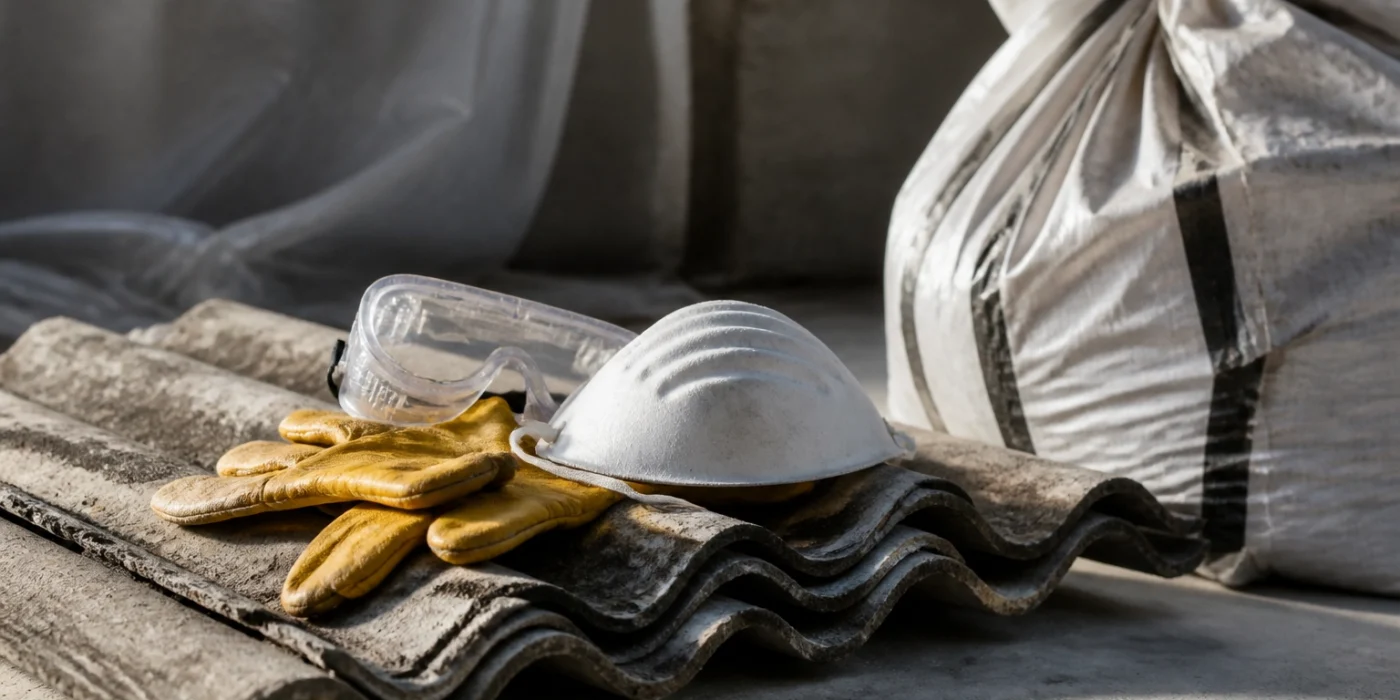
Hiring the wrong asbestos removal contractor in Newcastle can expose you to serious legal and financial consequences, and in many cases, property owners have no idea until something goes wrong. The licence a contractor holds is not just a formality. It determines exactly what hazardous materials they are legally permitted to handle, and whether the work they carry out on your property is compliant under NSW law.
Licensed asbestos removal is a regulated process for good reason. Asbestos remains one of the most dangerous building materials ever used in Australian construction, and improper removal puts occupants, workers and neighbouring properties at risk.
This guide is written for Newcastle property owners who want to understand the difference between Class A and Class B asbestos removal licences before signing any contracts. You will learn what each licence actually authorises, how to verify a contractor’s credentials, what happens when the wrong licence is used and why these distinctions are particularly relevant in the Newcastle region. By the end you will have the knowledge to ask the right questions and make a confident, informed decision.
Why Asbestos Removal Requires a Licence in NSW
Asbestos fibres are a proven carcinogen. When asbestos containing material (ACM) is disturbed without proper controls, microscopic fibres become airborne and can be inhaled deep into lung tissue where they remain permanently. The result is mesothelioma or asbestosis, both incurable diseases.
NSW banned ACM in new construction before 1990, which means any residential or commercial building built or renovated before 1990 carries a high probability of containing asbestos. In Newcastle, where significant portions of the housing stock predate that cutoff, this is a routine reality rather than an edge case. Demolition and renovation projects across suburbs like Hamilton, Mayfield and Broadmeadow regularly uncover asbestos, whether owners expect it or not.
Because the health consequences are irreversible, NSW does not leave removal standards to individual judgement. Licensed asbestos removal in Newcastle and across NSW is governed by SafeWork NSW under the Work Health and Safety Regulation 2017, which sets enforceable requirements for who can legally disturb, remove and dispose of ACM.
The licensing framework also directly addresses a well documented industry problem, illegal dumping. Improperly dumped asbestos waste creates ongoing public health risk that persists long after a job is complete, contaminating soil and exposing future residents or workers. Licensing ties disposal accountability to the contractor on record.
Friable vs Non-Friable Asbestos – The Distinction That Drives the Licence Classes
The licence class a contractor holds depends entirely on what type of asbestos they are authorised to handle and that distinction starts with the material itself.
Non-friable asbestos, also called bonded asbestos, contains fibres locked within a solid matrix. Fibre cement sheeting, roof tiles, and floor tiles are the most common examples. When undisturbed and in good condition, non-friable materials are relatively stable and release few fibres.
Friable asbestos is fundamentally different. It can be crumbled, pulverised, or reduced to powder by hand pressure alone, releasing fibres far more readily into the air. Pipe lagging, sprayed insulation, and loose-fill ceiling insulation are typical examples. Because friable materials shed fibres so easily, they carry a significantly higher health risk and demand much stricter containment, decontamination, and disposal controls during removal.
This distinction is what creates two separate licence classes. The additional protocols required for friable removal are not a procedural formality; they reflect a genuine difference in hazard level, which is why friable work attracts a higher licence class with more stringent eligibility requirements.
Both licence classes also cover asbestos-contaminated dust and debris (ACD), but only within the scope each licence permits.
For most Newcastle homeowners planning a wall removal, roof replacement, or full demolition in a pre-1990 property, non-friable ACM is the most likely find. However, friable material can be present in ceiling cavities, around old pipework, and in some textured paint products, which is why confirming the full scope before work begins matters.
What a Class B Asbestos Removal Licence Covers
A Class B asbestos removal licence authorises removal of non-friable (bonded) asbestos and ACM, plus handling of asbestos-contaminated dust and debris (ACD) generated during that work. That is the full extent of its scope.
When a Class B licence becomes mandatory
In NSW, a Class B licence is required once removal exceeds 10m² of non-friable asbestos or ACM. Below that threshold, no licence is required, though safe work practices and asbestos awareness training still apply.
What it takes to hold one
To obtain a Class B licence, a business must nominate a competent supervisor who has completed an approved non-friable asbestos removal course through a SafeWork NSW-approved registered training organisation (RTO) and holds a minimum of 12 months of relevant industry experience. Companies looking to employ qualified asbestos workers should note that this supervisory experience requirement is a hard eligibility condition, not a recommendation.
Fees and validity
The 2026-27 Class B application fee is $1,318.00, with a renewal fee of $727.00. The lower cost reflects the narrower scope of work authorised compared to Class A. Both Class A and Class B licences are valid for five years from the date of issue.
The hard limit: friable asbestos
A Class B contractor cannot legally handle friable asbestos under any circumstances. If friable material is discovered during a job, work must stop immediately and a Class A licensed contractor must be engaged.
What a Class A Asbestos Removal Licence Covers
Where Class B reaches its limit, Class A begins.
A Class A asbestos removal licence is the broader credential under NSW law. It authorises the removal of friable asbestos, non-friable asbestos, and all associated asbestos-contaminated dust and debris (ACD). Critically, Class A licence holders are also fully authorised to carry out all Class B removal work, making it the single licence that covers every legal asbestos removal scenario.
The eligibility requirements reflect that broader scope. Supervisor nominees must complete an approved friable asbestos removal course through a SafeWork NSW-approved RTO and demonstrate a minimum of three years of relevant industry experience. Applicants must also hold a current certified safety management system (SMS), a documented framework for identifying, controlling, and monitoring workplace health and safety risks specific to asbestos work. No equivalent SMS requirement applies to Class B applicants.
The 2026-27 Class A application and renewal fee is $7,260.00, compared to $1,318.00 for a Class B application. That cost gap reflects the greater risk, complexity, and regulatory oversight attached to friable asbestos work.
For residential demolition in Newcastle, a Class A contractor offers the widest lawful scope, a Class B licensee must stop work immediately if friable material surfaces.
Class A vs Class B: A Side-by-Side Summary
The two licence classes differ across every meaningful dimension. Here is how they compare directly:
| Class B | Class A | |
|---|---|---|
| Scope of work | Non-friable asbestos and associated ACD only | Friable asbestos, non-friable asbestos, and all ACD; includes full Class B authorisation |
| Supervisor experience | Minimum 12 months | Minimum 3 years |
| Safety management system | Not required | Mandatory |
| 2026-27 application fee | $1,318.00 | $7,260.00 |
| Licence validity | 5 years | 5 years |
Class B is sufficient for confirmed non-friable bonded material removal above 10m².
When Class A is required: any project where friable material is present or suspected. This includes full demolition of pre-1990 buildings, where ceiling insulation or pipe lagging may be concealed and cannot be ruled out before work begins. Because Class A covers all Class B work, it is the safer default licence to require when the full extent of asbestos in an older property is unknown.
One condition applies equally to both licence classes: neither permits illegal dumping of asbestos waste. Compliant disposal at an approved facility is a non-negotiable requirement under both Class A and Class B licensing in NSW.
How to Verify a Licensed Asbestos Removal Contractor in NSW
Knowing the difference between Class A and Class B is only useful if you can confirm which one your contractor actually holds. Here is how to check.
Ask for the licence number upfront. Request the contractor’s SafeWork NSW asbestos removal licence number before signing anything. A legitimate operator will provide it immediately and without hesitation.
Verify it on the SafeWork NSW licence register. The register is publicly accessible and shows whether the licence is current, its class, and any conditions attached. Do not take the contractor’s word for it; check the register directly.
Confirm the class matches your job. For a full demolition of a pre-1990 home, or any project where friable material is suspected, the contractor must hold a Class A licence. A Class B licence is insufficient for that scope regardless of how experienced or well-reviewed the contractor appears.
Request disposal documentation. Ask for waste transport certificates and receipts from a licensed waste facility. Compliant waste disposal is a legal obligation for licensed contractors, and requesting disposal documentation protects you if questions arise later.
Check AMR status for interstate contractors. Automatic Mutual Recognition allows interstate-licensed contractors to work in NSW, but the underlying licence must still be the correct class for the work being performed. Verify accordingly.
Ask for a written asbestos removal control plan. Licensed contractors are legally required to prepare one before commencing notifiable removal work. Its existence is a reliable indicator of genuine compliance; its absence is a warning sign.
For residential and commercial projects in Newcastle, working with Newcastle’s trusted demolition experts who hold current, appropriate licensing removes the verification burden from the outset.
What Happens If You Hire the Wrong Contractor
Verifying credentials matters only if the work that follows is compliant. If it is not, the consequences fall squarely on you as the property owner.
SafeWork NSW guidance makes clear that the duty to ensure lawful removal does not rest solely with the contractor, as the commissioning party, a property owner has obligations under the work health and safety framework and should seek independent legal advice on their specific exposure.
If unlicensed removal leaves asbestos contamination on your property or spreads to neighbouring land, remediation costs are your responsibility. The NSW EPA has powers to address illegal asbestos dumping and property owners should confirm compliant disposal documentation from their contractor before the job is complete.
Confirming your contractor’s licence class before work begins is the most straightforward way to protect your legal and financial position.
The upfront saving from an unlicensed operator is typically negligible against these combined risks. In Newcastle, where pre-1990 housing almost guarantees asbestos presence, the probability of something going wrong is not theoretical. The financial and legal exposure from non-compliant removal reliably exceeds any discount offered.
Why This Matters Specifically for Newcastle Property Owners
Newcastle’s licensing risks are not abstract. Much of Newcastle’s residential housing stock, including suburbs such as Mayfield, Hamilton, Adamstown, and Broadmeadow, predates 1990, and asbestos-containing materials appeared in over 3,000 building products of that era. If your property was built or renovated before 1990, encountering asbestos during demolition or renovation is a near-certainty.
Full demolitions in these suburbs routinely uncover both non-friable materials such as fibre cement cladding and floor tiles, and friable materials including ceiling insulation and pipe lagging. Because the full asbestos scope often cannot be confirmed until walls come down, Class A coverage is the more prudent choice for Newcastle’s best residential demolition projects rather than Class B alone. A knock-down and rebuild project in West Wallsend illustrates exactly this kind of scope, where material discoveries mid-job can change what licensing is required.
As noted above, the 10m² threshold applies even to what feel like minor renovations, a single internal wall or partial re-roof can breach it and trigger mandatory Class B licensing.
SafeWork NSW and the NSW EPA maintain ongoing compliance oversight for asbestos waste disposal across NSW, making proper documentation a standard requirement on every job.
Key Takeaways Before You Hire an Asbestos Removal Contractor
The compliance picture is clear. Here is what to act on before you sign anything.
- Match the licence class to the job. Class B covers straightforward non-friable removal above 10m². Class A is required for friable asbestos or any full demolition of a pre-1990 property where the complete asbestos scope cannot be confirmed in advance.
- Verify independently, check the SafeWork NSW public register directly.
- Make compliance part of the contract, request a removal control plan and waste disposal evidence before work begins.
- You carry responsibility too. As the property owner, commissioning unlicensed or wrongly-licensed removal work is not a defence against liability under NSW law. The obligation to ensure lawful removal sits with you, not only the contractor.
Hunter Valley Group holds the appropriate asbestos removal licensing for residential and commercial projects across Newcastle and the Hunter region. Compliant waste disposal is a baseline requirement on every job, not a point of negotiation. If you are planning a demolition or renovation on a pre-1990 property, engaging a contractor whose credentials you have verified is the single most important step you can take before work starts.